
“You going to the garage to practice juggling?”

My wife was carrying three bottles of water as she struggled to open the back door.

“Very funny.” Her tone was code for you’re not half as funny as you think you are. “These are for the guys working the trash pick up. It’s 98 degrees out there, and I figure they could use some cold water.”

This has become a weekly habit. And it is about a lot more than juggling bottles of cold water.

See Me?

Lately I’ve been wrestling with this question: do the individuals with whom I cross paths every day feel seen by me?

It is easy for me to acknowledge those with whom I am comfortable. Those who, on the surface at least, share my values. Those whose hopes and dreams align with mine.

An uncomfortable truth is how easily I am able to not see those who live outside my cushy field of vision. The scruffy young wait staff. The office cleanup crew. The person at the airport shoeshine stand.

It is disconcerting how easily I am able to avoid the awkward misfit who doesn’t conform. Or the person who embraces a different faith. Or no faith.

The ones who are the least like me are the most challenging for me to get beyond externals and see the human being.

It is astounding how easily so many in plain sight can become invisible.

This kind of selective vision of personhood eats away at the fabric of neighborhoods, communities and nations.

In the rock opera Tommy, the recurring plea is for the connectivity virtually every person needs — “See me, feel me. Touch me, hear me.”

. My f. riend Brian Kenneth Miller, who speaks to groups around the world on Human Connection, puts it this way: “everyone deserves to feel heard, understood and valued.”

What Every Person Deserves

Everyone needs connection.

It feels like this might be one of the questions of the moment. While norms feel shattered and connections fractured, can we rethink the way we engage with those with whom we cross paths?

The implications could be profound.

Bridges might be built…bridges that could lead to new and productive conversations. We might learn things about neighbors, far and wide. We might identify some hidden blind spots. Maybe.

Tho”se are the acknowledgments. The problem is if we do nothing, nothing changes.

A Challenge

Cynicism is easy. If that’s your choice, I get it.

Besides, really seeing those with whom our paths cross isn’t the easiest thing to do. Past experiences and preconceived notions inevitably challenge our better angels.

Here”’s an alternative idea.

Deciding to see things differently is where change begins. And this brings me back to the story of my wife juggling water bottles.

Today was another trash pick up day. And even though she wasn’t around to hand the guys a cold drink, there is clear evidence of a bridge being built. Up and down the route, trash bins are empty and (more or less) left where they had been staged for pick up. But ours had been rolled up our driveway, and neatly positioned just outside the garage.

A big thing? Heck no.

And that’s the point. It sounds trite, even naive to say big things begin with small acts. But it may be more true today than ever.

The challenge: look for a way to say “I see you” to someone who might need to hear that message.

Maybe stop for a chat with the person in the back office. Or tell the person clearing your restaurant table that you appreciate the work they do. Or check on the neighbor you barely speak to (I’m pointing at me when I say this).

Or hand a bottle of cold water to those who pick up your garbage..

You might find out you’re into bridge building.

****:**********************************

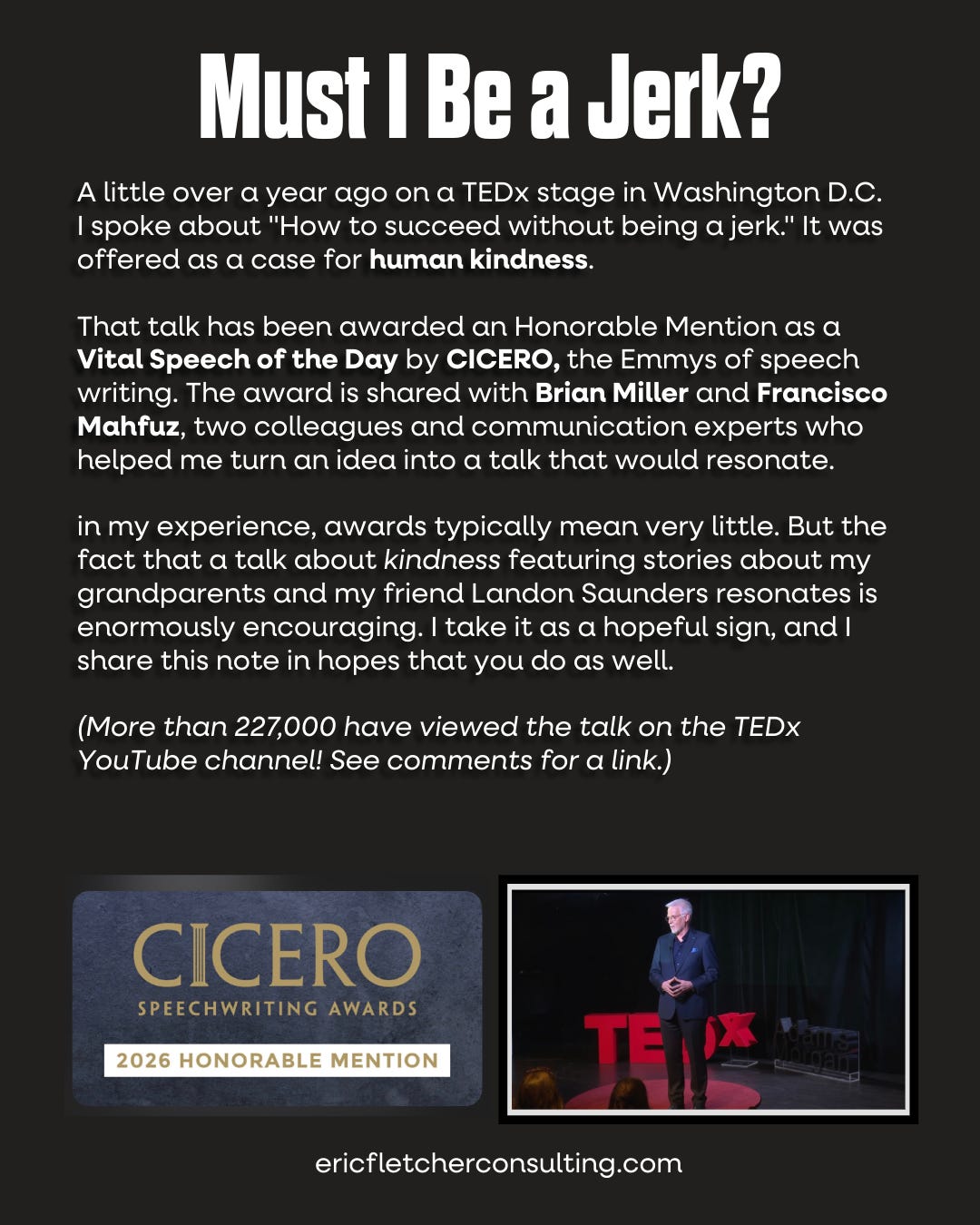
If you appreciate this article, check out my TEDx Talk, How to be successful without being a jerk.

I help successful professionals build a business that aligns with their values and aspirations. To schedule a discovery call to see if my framework is a fit for you, email me at eric@ericfletcherconsulting.com, or access my calendar here.

It felt like I was standing a little taller…moving with more confidence. I was headed down the airport corridor toward my gate, armed with a status that implied I was special…that I deserved a bit of pampering.

I was young and naive.

The ego boost was dashed when it became apparent that more than half of my fellow travelers that morning were more “elite” than I was. The label ascribing status meant nothing.

Several decades later we see this everywhere.

Does anyone really believe the VIP email list comes with any real perks? Are you confident you’re getting premium quality every time you see that label? Am I actually a preferred customer?

This is the problem with labels. They’re just words. Often over used to the point of meaning little.

Strategy” has become just such a label.

It is used to infer importance…intended to say “this plan, initiative, decision, question or move rises above ordinary. It is “strategic” in nature.

I regularly talk to professional service organizations that invest significant resources in planning, launch initiatives, call them strategic, and await results commensurate with the weight of the label.

Then comes disruption.

It may be economic pressure. Or a consequential personnel change. Or a catastrophic event. Or the realization that it is taking too long to see any results.

Whatever form disruption takes, it is amazing how quickly the strategy becomes irrelevant, impractical or inconvenient.

Not strategic at all.

A Ghost Protocol

The numbers should scare us into at least rethinking our approach.

After investments of thousands, sometimes even hundreds of thousands of dollars, a breathtaking number of so-called strategic plans fizzle long before even modest goals are realized. Research puts the failure rate at between 60% and 90%, depending on the size of the organization and the industry.

Poor execution is typically cited as the reason for the failure. But the problem is greater than one of execution. It is one of alignment.

Here’s what I mean.

The degree to which principles, areas of focus and specific planning survive the honeymoon period often corresponds to the degree to which a subset of the plan found a champion.

Otherwise, and often even when a champion exists, only the pieces of the exercise that generate the least amount of organizational friction receive much attention.

Not strategic at all.

Over time, fragments of a direction haunt the entire idea of planning.

A lack of alignment in leadership and across divisions of the organization — that is, the absence of a shared view of how to address the future — gives rise to new frustrations. This results in a hit-or-miss rate when it comes to firm-wide adoption.

Eventually the feeling that there is no real direction, an especially uncomfortable feeling in a volatile marketplace, can prompt organizational leadership change. With a change comes a whole new batch of ideas for strategic direction.

Rinse and repeat.

What Constitutes Strategy?

Let’s talk about what “strategy” is not.

It is not tactics. Or a plan. Or an initiative.

Strategy is a philosophySeth Godin calls it the philosophy of becoming.

So, if we run with that for a moment, strategy provides the philosophical underpinnings that help define the steps you take in order realize what you hope to become.

There will certainly be disruptions to the steps put in place today. To deal with this, a plan of action must be able to flex and even change in order to become relevant in a new reality.

But an organization’s vision of what it hopes to become is much less subject to disruption. In fact, market shifts might serve to deepen an organization’s resolve around direction and purpose.

The challenge for most organizations frustrated by the planning process is that arriving at a shared philosophy of becoming is not easy. In fact, critical steps are often given short shrift, or ignored altogether.

A framework. Not A Plan.

Enter our three-part framework that creates alignment around a philosophy of becoming, and provides a foundation for effective planning.

Part One — Shared Vision

If the word “vision” is a stumbling block for you, replace it with “Aspirations.” The idea here is that a common goal…agreement on what you want to become…is the glue that holds things together. A lot can go sideways; but a shared vision keeps eyes fixed on the prize.

Part Two — Core Values

What three or four values do you and your team hold sacrosanct? Agreement here not only becomes important cultural fabric; it provides guardrails for every consequential decision you’ll face on the way to becoming.

Part Three — Prioritized Focus

If you find Vision and Values a bit too “soft,” this third part of the framework should appeal to the left side of your brain. Prioritizing focus is the science of what you hope to become. To the degree it is possible to identify (or create) a hierarchy that accelerates the journey at any turn, this should be agreed upon as foundational. And this jumpstarts the development of a plan of action.

Put this framework in place and you have the basis for alignment…something around which every single member of a team can rally. Not to mention, a life expectancy of more than six months for direction. When the unexpected happens, make the necessary tweaks to your plan of action without having to alter the philosophy that drives you.

You Have The Right To Name It

With all of this said, you should call it whatever suits you. Labels only matter when they provide accurate context. If it causes less friction, I would vote to label the entire process “Strategic Planning.” Just resist the temptation to skip over this three-part framework. It may not be your favorite thing to do; but it is the difference between plans that fail and those that actually function as instruments for becoming who and what you want to become.

***********************************

To download a complimentary copy of The Business Development Playbook — a look at our six-step framework for business development, click here, and scroll down to the FREE offer.

I work with a limited number of clients, who want to follow a proven framework for growth in order to build a business aligned with their aspirations. If you’d like information, send an email to eric@ericfletcherconsulting.com. We

Screenshot

I was meeting a colleague for coffee. She wanted to introduce me to a potential new hire.

“You’re going to love this guy. He’s so nice.”

I half-joked, “I’m not too sure being ‘nice’ is an asset in the role we’re trying to fill.”

Sure, it would be…nice…to have an agreeable person filling the position…someone who isn’t confrontational. Someone who wants to get along.

That’s what we tend to mean when we say someone is “nice.”

“But will he be able to have the tough conversations?,” I asked. “To push back? That’s what we need.”

But being nice is not the same as being kind.

With hints of a frown, Sylvia said, “I thought we were trying to get rid of all the jerks.”

Costly Conflation

She was right; we did want to weed out the jerks. You know the type — those prone to verbal assaults. Those who repeatedly displayed a lack of respect for others. The ones who drove others to leave. Those who might even throw a chair.

Nice is a characteristic. A trait. Don’t get me wrong — there are aspects of being nice that are admirable, and I will vote for nice over rude. But I was interested in building something better — a team that practiced intentional kindness.

This is a disciplined decision.

For some of us it requires more practice and discipline than for others. But we can all get there…if we care enough.

Some think being kind means being soft — unable to have uncomfortable conversations…or unwilling to face difficult moments. A pushover.

But intentional kindness is not soft, and is often far from easy.

It signals an uncommon value-set that says whatever the circumstance, nothing is more valuable than a person.

. The decision to let this value proposition define behavior — even in the most difficult interaction — challenges present day norms.

This isn’t about winning through intimidation or watering down tough feedback. And it sure isn’t intended to suggest that being kind means I have to lower priorities or “give in.”

What we are suggesting is this:

  • Without respect to topic or circumstance, every encounter with another person should be driven by an understanding that nothing is more valuable than a human being. No investment produces a greater return than those we make in people.

This may feel radical, I know — some will say naive, or even silly. In a competitive, cut-throat world, turf must be protected. At all costs. There is no room for kindness.

But what if discounting kindness is one of the most costly mistakes we make?

What The Research Shows

In a recent TEDx Talk — How To Succeed Without Being A Jerk — I go as far as suggesting that even the simplest acts of kindness serve to differentiate. They feel so rare, while crass meanness and blatant disrespect feel like the acceptable order of the day.

In their July 2025 article for Harvard Business ReviewNicki MacklinThomas H. Lee and Amy C. Edmondson make the case for Why Kindness Is Not A Nice To Have…even in the rough-and-tumble world of the workplace.

For starters, companies that neglect kindness pay a price in terms of:

  • Increased employee turnover
  • Higher levels of absenteeism
  • Erosion of trust
  • Breakdown in team communication
  • Loss of time due to tension and conflict
  • Negative impacts on customer experience

On the other hand, research says companies that emphasize kindness have:

  • Stronger relationships
  • Better collaboration
  • Higher engagement
  • Improved retention

If this isn’t enough to make you rethink things, the authors dispel the idea that kindness is one of the so-called “soft skills.” They suggest that it can be taughtand even measured. It is an intentional act — not just “something we feel.”

And it should be high on any leader’s agenda.

The organizations that aspire to succeed and lead find a way to institutionalize kindness…even as they embrace AI.

An Instant Differentiator

But intentional kindness is more than a discipline. Few things can change the shape and tone of daily interactions more than one person who practices kindness.

So if you lament the erosion of decency…if you’re searching for a way to instigate a positive change wherever you live and work…make the practice of intentional kindness a priority.

It is as simple as treating others the way you’d like to be treated — a value many of us were introduced to while we learned to walk and talk.

As for Mike — the individual Sylvia was high on — turned out he was much better than nice, and he got the job.

A postscript: I am extremely encouraged by the early response to my TEDx Adams Morgan Talk. After hitting YouTube on July 8, it ranked as the 11th most viewed new talk in the world before the end of July. As of this publication more than 95,000 have tuned in. If you’re in this count — THANK YOU! I take this response as an indication that we are hungry for something better than the ruthless attitude that we are exposed to every day.

Anyone can become a successful business developer. Even a rainmaker.

I say this without reservation…knowing many will disagree.

Like Mindy did.

She was upfront, telling me the first time we sat down to discuss growing her practice that she just didn’t have the right personality.

“Networking events are worse than a root canal,” she told me. “And when it comes to talking someone into hiring me…I am not a salesperson.”

Mindy had bought into the idea that you’re either a born rainmaker, or you’re not.

Continue Reading If You Feel Like You Have To Become A Different Person To Succeed At Business Development, You’re Doing It Wrong

Do These Three Things To Rock Q-4 and Jumpstart 2025

Conventional wisdom for many professional service providers whispers that we’re fast approaching a moment when the story for this year will be written, and there’s not much that can be done to impact this year’s revenue picture.

Before you buy this idea, can we spend a moment rethinking?

Continue Reading Don’t Throw In The Towel On Your 2024 Goals


Don’t look now, but conversations are becoming increasingly rare.

The fact that there are plenty of attempts at messaging doesn’t mean any real conversations are taking place…

Just because there is measurable attention being paid to a given topic or hundreds of hours of talk devoted to a critical issue is no guarantee of progress.

Need a stark case-in-point?

Continue Reading Oh No! Not the same conversation…again!

The sentiment expressed by Vince Lombardi, the legendary former coach of the Green Bay Packers, has reached manifesto status — “Winning isn’t everything; it’s the only thing.”

At the other end of the spectrum is the antiquated idea derived from the Grantland Rice poem ‘Alumnus Football’ (1908) — “It’s not whether you win or lose, it’s how you play the game.”

Though I’m usually up for a spirited debate, let’s stipulate that it is one thing to believe that winning is the point when we’re talking about our favorite competition.

But an almost blind obsession with finishing on top is far more ubiquitous than just in the games we play

The question is — when competitive juices drive the pursuit of a win at all costs no matter the arena, what is revealed about what we value most?

Surely there are important encounters where winning is decidedly not the only thing.

Continue Reading With deference to Lombardi, Winning is NOT the only thing

Conventional wisdom for lawyers suggests that we’re fast approaching a moment when the die for this year will be cast, and there’s not much that can be done to impact this year’s revenue picture.

Before you buy the idea that there is nothing to be done that might increase revenue this year — not to mention, jumpstart 2024 — can we talk.

Continue Reading You Still Have Time To Grow Your Practice This Year. Do These Three Things.

Wherever business development initiatives aren’t delivering ROI in the form of increased revenue, the problem often boils down to missing the target more often than not.

It is easy to do.

An entire industry has a vested interest in convincing you that getting your name out there amounts to smart business development. Once you make this leap it is tempting to buy the ads, sign up for the sponsorships, get the copy points and colors just right on your website, catalogue every capability…and then wait for the market to beat a path to your door.

If neither time or budget is an issue, and assuming your visibility campaign in some way differentiates you from everyone else — this might work.

But odds are you’ll over spend, waste time and miss connecting with any real targets.

Continue Reading When BizDev Efforts Fail To Increase Revenue, You Have An Aim Problem

  1. Can you name the target(s) key to your success?
  2. Do you know and understand the core concerns of your target(s)?
  3. Do you have a clear solution/answer for these concerns?
  4. How will you create visibility, deliver value and build trust with your target?

Whether you are marketing a professional service, selling a product or seeking support for a cause, four questions provide the framework for increasing revenue.

Continue Reading Four Steps That Will Increase Revenue