


No matter what you’re building, simply creating the state of the art is no guarantee anyone will care…much less beat a path to your door.

You don’t need me to tell you this.
Every day someone is offering a new state-of-your-industry service or solution. Some might actually live up to the hype. But most will have trouble attracting the attention necessary to maintain viability.
Yet, enterprises of all types repeatedly behave as if they believe their offering is the exception. That it is so exceptional it will rise above the noise.
More often than not, these hopes are dashed.
One reason for this is that it is tough to buck precedent.
A Hard Habit to Break
“The way we’ve always done it” comes with a measure of comfort. Where there is a risk averse mindset and an aversion to selling in the first place, it can feel foolish to consider experimenting. A well worn path provides a measure of comfort…not to mention a dose of CYA.
Any new process means new investments, operational headaches, and requires more than a little nerve.
As a result, we all know scores of endeavors — established firms, entrepreneurial ventures, institutions, worthy causes — that, year after year, employ an approach to sustainability and growth that has repeatedly disappointed.
For example, consider the reality in business law firms. when it comes to initiatives intended to increase revenue, “the-way-it’s-always-been-done” consistently produces modest to negligible organic growth in all but a handful of firms when numbers are adjusted for inflation and lateral partner acquisition.
As AI imposes whole new economic models on the professional services industry, relying on the same old marginally effective business development strategies that have been marginally effective for decades seems to border on insanity.`
A Proven Approach: A New Framework
Referrals have always been the greatest source for new top tier connections. And before you object that it’s just another one of the ways we’ve always spread the word about something, let me underscored one critical note: it produces results.
Seasoned rainmakers know this. They invest heavily in the development of a network that grows the universe of individuals who know them, trust them and will happily issue a recommendation.
Community organizers and successful fundraisers understand the dynamic. They focus resources on enlisting opinion leaders early in any campaign. The success of an initiative rests on having the right advocates lending their names and opening important doors.
Social media has added a new dimension to the value to be derived for a brand from an active network of influential advocates.
And advertisers have long understood that word-of-mouth messaging, a personal recommendation coming from the right source, is priceless.
Heres the point.
You can dramatically change your organic growth experience by investing in the development of strategic allies. That is, a group of individuals already connected to and trusted by your most coveted prospects.
The right allies do at least three things that are critical to generating new revenue:
- Allies jumpstart awareness for your initiative;
- Allies provide strategic visibility around the value you offer;
- Allies transfer to you a measure of the trust bestowed on them by your most coveted targets.
All of these mean you move more quickly from an unknown commodity to a productive relationship. And, assuming you play your cards right, to eventual trusted advisor status.
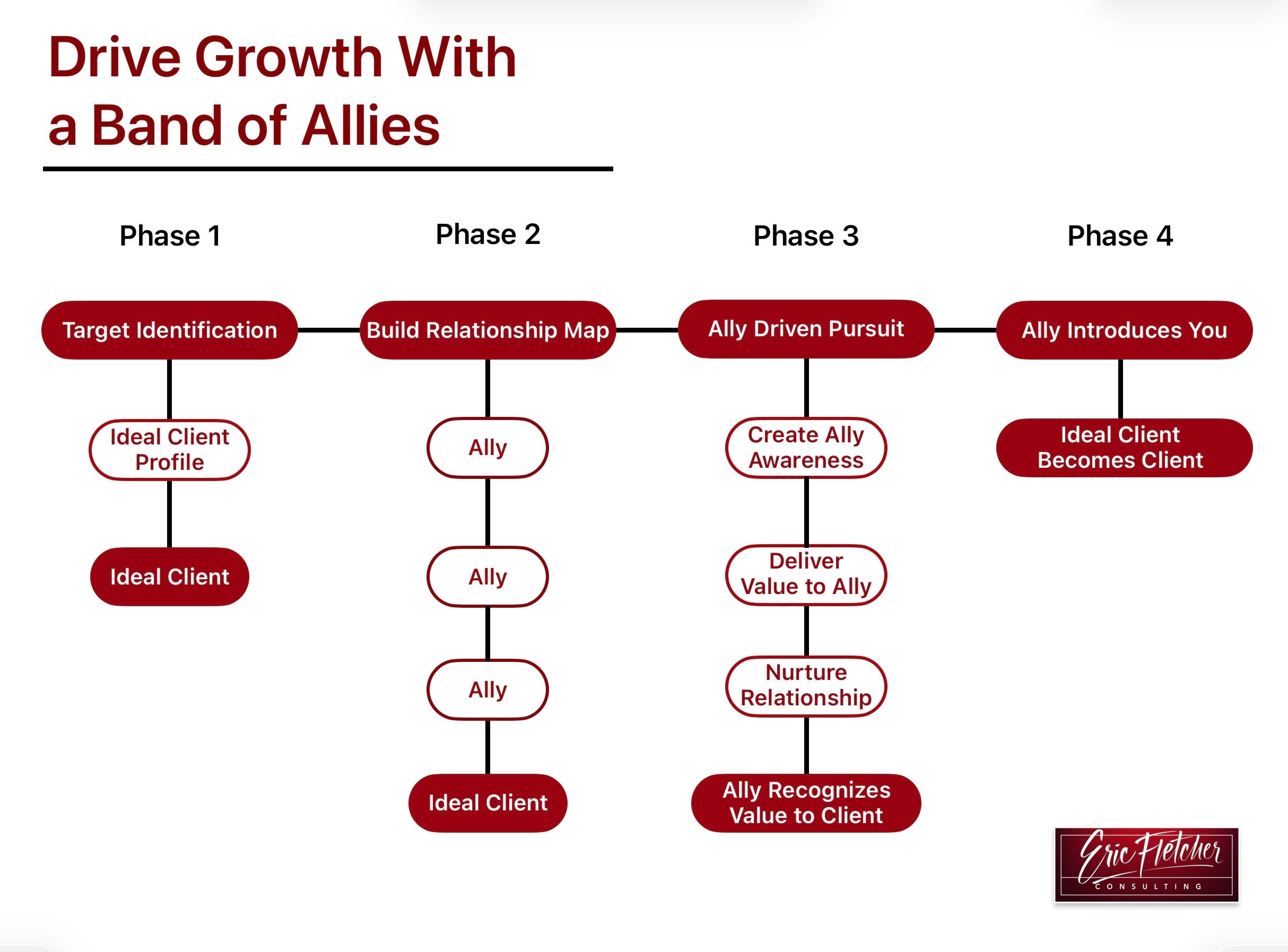
Here’s a high level framework you can copy, brainstorm around and adapt to your current effort to build or grow a practice, a community or a cause.
Building A Band Of Allies
Step 1: Create An Ideal Client Profile (ICP).
This is about knowing precisely who you want to work with. The more precise, the better. If you need to begin with broad generalities, go ahead; but ultimately you’ll want to get as close to naming specific names as possible. Note: the more specifics you can include in your ICP the more AI can be a research partner in naming names.
Step 2: Identify specific Targets that match your ICP. (Begin with three.)
Step 3: Create A Relationship Map For Each Target.
Identify individuals already associated with a specific Target you’ve named. You’re looking for a relationship (or a group of connections) that, when convinced of the value you bring to the table, will introduce you to the Target they are connected to. For example, an estate planning attorney connects to CPAs, Financial Planners and Trust Officers because these groups work with high net worth estates.
Step 4: Research Each Prospective Ally.
.
The ultimate goal here is two fold: (1) to insure that you have a path…via an individual or a group of individuals…that leads directly to the decision maker of your Target; (2) to learn as much as possible about how you might offer value to your Allies. For example, the estate attorney noted above conducts regular “lunch-and-learn’ sessions on legal estate planning issues for high net worth families.
Step 5: Work The Relationship Maps
The goal is to connect as quickly as possible with the individual closest to your Target, and deliver relevant value to that individual in a way that ultimately results in a referral to the prospective client. For example, in sharing information related to high net worth estate planning with his allies, the estate attorney develops trust, and is invited by his allies to meet with the Target for customized counsel.
This Isn’t Rocket Science
This simply bakes the power of referrals into an intentional strategy.
Measurable organic revenue growth belongs to the organizations and individuals who are rethink their approach. Creating and nurturing a referral pipeline is not a new concept. This Allies framework simply builds on the most effective organic growth tool human beings have imagined — a personal referral from a trusted source — and bakes it into an intentional strategy.
***
If you’d like more information on how to create a pipeline of allies and dramatically retool your growth initiative, shoot me a note. It will be a pleasure to schedule a complimentary 45-minute conversation — eric@ericfletcherconsulting.com